What?
At our school all students in Year 3-6 have their own school Google Suite for Education account. The PCT of a Year 3 class was teaching them to use their account and had on display each child's class login and password. A parent brought to my attention that her daughter's work had been tampered with as a result of the passwords being on display (another child had signed into the student's account and ruined their work because of the passwords being insecure due to teacher error).
So What?
It is important that our staff uphold and model best practise with using digital technology and being a digital citizen. A privacy guideline from our policy states "We have reasonable safeguards in place to protect personal information from loss, unauthorised access, use, or disclosure. These safeguards include the use of individual logins for computers" (2018). In this case, the young PCT had breached privacy by displaying the logins and passwords for all students in her class, causing a student to take advantage and destroy another child's work (digitally). This made tracing the offender very difficult, as the document didn't have shared authorship; the offender used the child's login/password. As a school leader I was able to use the history feature of the G. Suite to print evidence and timestamps of when specific changes had been made to the student's document and provide this as evidence for the parent.
Now What?
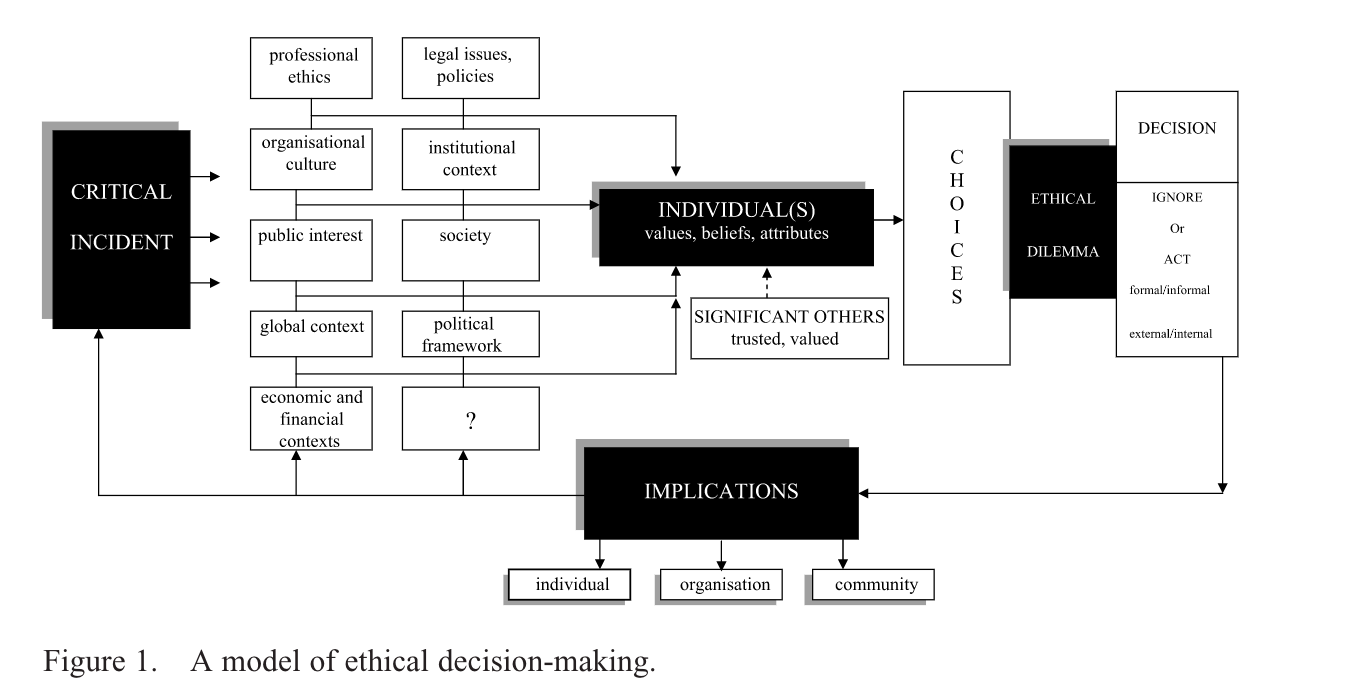
The dilemma for myself and the PCT was how to do to use this as a learning opportunity for these young learners regarding sharing passwords, appease the parent that action had been taken, and support the PCT on how best to manage digital technologies in class with her learners. On reflection it would have been useful to have been able to use Ehrich et al. (2011) “model of ethical decision-making” as it would have not only given ourselves some clear directions but also may have been useful to show the parent how I thoroughly considered all aspects of the breach (the seriousness of the issue) and dealt accordingly. The strength of using a model like Ehrich et al. (2011) is the way in which it breaks down each of the components of the incident. Whether these are around legal issues, professional ethics or areas of public interest and relates these to the implications for us as individuals, organisations and communities. In this case, I went into the classroom and took several lessons for the PCT/students around digital citizenship and strong passwords. This satisfied the parent, the learners understood the seriousness of the issue and learnt how to protect their password, the PCT felt supported and as a leader I felt satisfied the dilemma had been resolved for all involved. I had acted with professionalism and integrity upholding our school Code of Conduct (2016) when interacting with the student/s, parent, and staff member with this dilemma.
Word count: 541
References
Ehrich, L. C. , Kimber M., Millwater, J. & Cranston, N. (2011). Ethical dilemmas: a model to understand teacher practice, Teachers and Teaching: theory and practice, 17:2, 173-185, DOI: 10.1080/13540602.2011.539794
Rolfe, G., Freshwater, D., Jasper, M. (2001) Critical reflection in nursing and the helping professions: a user’s guide. Basingstoke: Palgrave Macmillan.
Sunnyhills School Board of Trustees, (2018). Privacy Guidelines. School Docs retrieved from http://sunnyhills.schooldocs.co.nz/index.htm?toc.htm?18805.htm
Sunnyhills School Board of Trustees, (2016). Code of Conduct. Internal School Document.
