Projecting positivity and continuous improvement...
I am a First Time Principal at a primary school in Auckland, New Zealand. This blog is to share my leadership adventures. I like to inspire learners (both students and teachers) to be the best learners they can be and promote future focussed pedagogy.
My post this week relates to Professional Online Social Networks. In response to this I will be reflecting on my own experiences as an early adopter of social media and the opportunities this has created for me professionally. I will discuss this considering Jay and Johnson's (2002) reflective model to unpack it. This takes the form of a three step reflection process that is descriptive, comparative and critical.
Descriptive
I consider myself to be a connected educator and early adopter of social media for professional use. I have documented this journey, as evidenced in several blog posts and in particular this early one from 2009 on my top 3 tips for getting connected online. In this post I suggest using "new" web 2.0 tools such as opening an RSS reader account, using social book marking (Delicious) and starting connections using Twitter! I also refer to my developing Professional Learning Network (a PLN) which back then was a very new term and predominately spread throughout New Zealand. Now, some 10 years later, my PLN is global and these digital connections I can call upon because of the on-going nurturing of interactions via social media, making the vast physical distance of global connection virtual and compact in the palm of your hand (on your device).
Comparative
My experiences parallel the video produced from Office of Ed Tech (2013), shared for our week 29 course work which discusses how being connected is one of the number one tools for being a 21st Century Educator, the isolation of the classroom (or school environment) is no more through the magnification of the transformative power of professional learning via technology (social media). At the time of writing this post their was limited responses in our cohort survey tool to compare. What I can say from my own observation of being connected over the last decade is that the use of Facebook for professional social networking has increased with the use of "groups" and of interest over this time the development of #hashtags and frequency of #twitterchats to share professional knowledge.
Critical
As an advocate for using professional online social networks, I reflect back on this 2013 Ignite presentation that I shared in which I spoke about being connected, disconnected and reconnected.
It takes a lot to nurture your online social media profile and connections. The rewards of doing so open a world of professional growth that I would have never had opened if it weren't for social media/technology. I would recommend that anyone wanting to start being a more connected educator to follow the simple "Follow 5, Find 5, Take 5" method suggested by Whitaker et al., (2015) as a way nurturing a PLN. As an employer, being a connected educator is an important factor in considering whether a candidate is suitable and I do review the online presence of applicants. One of the key points of difference I have in my tool belt when going for leadership roles (I believe) is that my employer knows that it isn't just my skills, and knowledge that they are employing, but that of my wider collective and connective PLN too, which I can access readily!
Opportunities afforded to be by being connected (& associated blog links/video):
Jay, J.K. and Johnson, K.L. (2002). Capturing complexity: a typology of reflective practice for teacher education. Teaching and Teacher Education, 18, 73-85. Office of Ed Tech. (2013, Sep 18). Connected Educators. [video file]. Retrieved from https://www.youtube.com/watch?t=216&v=K4Vd4JP_DB8
Whitaker, T., Zoul, J., & Casas, J. (2015). What connected educators do differently. New York, NY: Routledge.
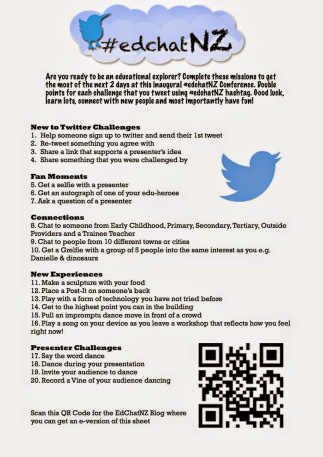
Term three has had a busy start for me with the first three Saturdays consumed with connecting face to face with my online PLN at #educampAKLD, #educampTT and the inaugural #edchatNZ conference. I was waiting for the end of this third event to write a post and was procrastinating, however thanks to being challenged by Bridget Casse to participate in the #edchatNZ meme I am prompted to waste no more time!
If you get included in the blogging meme: copy/paste the questions and instructions into your own blog then fill out your own answers. Share on twitter tagging 5 friends.
1. How did you attend the #Edchatnz Conference? (Face 2 Face, followed online or didn't)I was lucky enough to attend BOTH days Face 2 Face
2. How many others attended from your school or organisation?I was flying SOLO at this one however I got to carpool both days with @Mrs_Hyde, @Carobush and @annagerrit which made the trip to the other side of town a lot of fun and giggles.
3.How many #Edchatnz challenges did you complete?I got several Grelfies done over the two days, this really cheezy one first thing on arrival on Friday with Annemarie, Caroline and Diana...
and this Geeky (I say Gorgeous) Glasses Grelfie on Saturday with Bridget Casse @bridgetcasseand Phillipa @AKeenReader I also love this one with two people that I admire greatly Annemarie and Mark *Plus I did get people up and dancing in the very first session with Andrew Cowie (thanks to the assistance of Annemarie) video evidenced here: http://youtu.be/JMUha6UiaKc which scored me this wonderful conference prize of a Samsung Galaxy Gear (great because I'm a Samsung S4 user & Android fan)
4. Who are 3 people that you connected with and what did you learn from them?Amy McCauley - Google Sites session: subscribing to changes & making a filter in Gmail in box to sort theseAndrew Cowie - Ghostery.com an app to show what other sites are tracking your movements onlineReid Walker - the joy of seeing a tweep having "aha" moments at Pam Hook's session for primary teachers on Solo Taxonmy
5. What session are you gutted that you missed?Modern Learning Environments with Mark Osborne.
6. Who is one person that you would like to have taken to Edchatnz and what key thing would they have learned?
I would of loved it if Tana Klaricich could of been there in person but I know she was following via our twitter updates.
7. Is there a person you didn’t get to meet/chat with (F2F/online) that you wished you had? WhyI wanted to make a connection with Karla Hull from Ngatea School. I've been connecting with her a few times recently on twitter and she wasn't able to attend in the end. I like what I've read via twitter and the blogs coming out of Ngatea School on transforming learning spaces.
8. What is the next book you are going to read and why? Alan November "Who owns the learning?" suggested this week to me twice and it's under $20 on Book Depository http://goo.gl/k7hDSj It is about students using technology to drive their learning.
9. What is one thing you plan to do to continue the Education Revolution you learnt about at #EdchatNZ?
It's ok to be a lone nut, but having a mixed group of nuts is better - variety is the spice of life - seek out the nut in others to try something new.
10. Will you take a risk and hand your students a blank canvas?In my role as a DP our staff are my initial 'students' so giving out a blank canvas supported by 'paint by numbers' is more my style
Recently I have helped a good friend get "connected" in the on-line world of web2.0 applications. In reflecting upon this help (or coaching sessions) that we have had, I thought it would be good for me to record what we did together so that others who are beginners on the web can become connected too.
I am by no means an expert and still am learning and discovering things everyday, however the more you immerse yourself the more you learn. There are so many wonderful people out in my PLN (Personal Learning Network) that have already made blogs and wikis to share how to do these things too. However, by recording my journey I can add my own reflections on why and how I find things. I would consider myself an experienced novice, open to learning. I will go over what we did and in the order we did it (as this may help?). Starting out your digital footprint I use the same log in user identity so that others can find me (and I don't have to remember what I've signed up as). For my web2.0 world I have (in most instances) used digitallearningnz as my user name and then used a strong password (including letters and numbers). I strongly recommend different passwords for online banking and for your workplace computer password (as often you may have to give your work log in password to a technician). I am a visual learner and have found it useful to use YouTube.com to watch many videos to discover how to do things or what things mean. I will include several of them in the following tips. Tip #1: Open a Reader Account Watch the following video clip to explain what a RSS Reader does and why you will need one. I got my friend to set this up first so that the subsequent Tips could fall into place.
To get started I also found it useful to watch the video from Google too:
I find it quite good once I have subscribed to a blog and it is loaded into the reader to rename the front of the blog subscription with the author of who the blog belongs to, e.g. when you subscribe to my blog it with say "Digital Learning" but to make it more identifiable in my subscription list I rename to say "Justine Driver: Digital Learning" for me this is one way of remembering who the blog belongs to in my PLN (Personal Learning Network). Tip #2: Social Bookmarking using Delicious Watch the following video clip to find out what social bookmarking is and why it is beneficial for you.
In delicious my account is digitalearningnz (note only one "l" when I joined, as I typed too fast and misspelt my own user name! LOL)Please feel free to add me to your network once you have joined to see my bookmarks.
What I find really important is that you MUST put the buttons on your Internet browser (this is what makes it quick and easy to use). It is great knowing that if my computer crashes my bookmarks are not lost and I have even more at my finger tips with my network.
I also find it important that when I find a blog (and I like the content) that I add it immediately to my READER account by subscribing to the RSS feed. A good way to find out where to find interesting blogs is to look and see whether the blog has a list of blogs that author likes - follow those links and start bookmarking and subscribing.
Tip #3: Twitter I often get asked what is Twitter? or why should I be on Twitter? I find Twitter to be my most powerful learning tool at the moment. One member of my PLN asked recently "what are the 3 top reasons you use Twitter for?" 1)I have the ability to provide quick help and assistance to others and similarlyreceive help/advice. 2)I get near instantaneous connection with an extremely diverse group of people who willingly help and share; and 3) by using Twitter I have an increased ability to achieve a deeper personal connection to people in my PLN compared to normal blogging (thanks to @suewaters as this was her top 3 reasons to use Twitter and they sounded better than mine, but I agree. This video clip explains:
Again I find that once you have made a connection by following someone (feel free to follow me by clicking here) you can then follow some of the people that person follows and check out their web pages too.
I find it really important that you should fill out your BIO details in your settings section when you sign up to Twitter. Some people let anyone follow them however I only let teachers or educators of some kind follow me (so make sure you include these details in your bio). I also am selective about who to follow as time is precious and I don't want to read through stuff that doesn't interest me (this is just my personal view and others would comment differently).
I also didn't realise when I started with Twitter about two important functions 1) @replies - when someone does a post to the right of their message is an arrow that you click and your message will be put into that person's @replies box directly and it is a public message or if you want to write a message to someone specific you need to start the message with the @name symbol; and 2)Direct Messages (DM) are private messages that only you and the person receiving can read and they appear in your DM tab.
So you've done these first 3 Tips now what?
Now it is your task to develop your PLN by surfing the web; setting aside a little time each day to do some tweets (mini-blog posts) up to Twitter and make some connections. As you make connections and find websites remember to book mark them on your delicious and add them into your Reader. Ask questions and begin to make comments on blogs.
What's next? Starting your own blog and learning how to use the huge array of web 2.0 applications that there are. But this will be another post for me to write, first it is time to immerse yourself and see what is out there in the web. Enjoy and please feel free to leave a comment or ask a question.