Showing posts with label reflections. Show all posts

Saturday, 31 March 2018

TML Week 17: Reflective Practice

Reflective practice is one of those terms that is touted as current best practice for being responsive to the needs of our learners and dare I add in my leadership role, responsive to our staff and community needs.  It has become an integral part of the cycle of teaching as inquiry for effective pedagogy, a practice that is now widespread as a means for educational improvement and improved teacher quality. However after reading through the article by Finlay (2008), I would postulate that it is not done with the depth of understanding to truly be reflective.  The important element of critical analysis required for reflection-on-action as Schön (1983, cited in Finlay, 2008) describes as ‘after-the-event-thinking’ is often missing. In this post, I attempt to use a three step model by Jay and Johnson (2002) to critically reflect on my own reflective practice.


Jay and Johnson (2002) Reflective Model
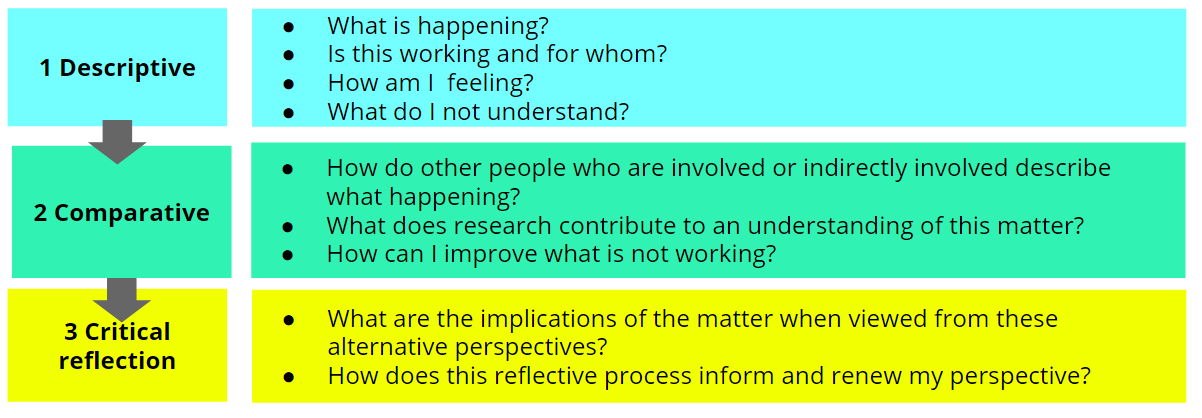
Stage 1: Descriptive
In my own practice, as an educational leader, I do not believe I reflect to the best of my ability, despite good intentions.  In a time poor environment where I am driven to juggle many tasks and manage events on a situational basis, I feel I need to be more selective and spend time to reflect and draw clarity to the events around me for future learning and leadership. I am often caught up with situations that arise unscheduled, where I have to be agile and this requires me to take a reflection-in-action (thinking while doing) approach.  I often find that I then personally reflect on my own after a situation or event on my actions, my feelings and what I would do differently in the future based on my own gut feeling and hindsight.

Stage 2: Comparative
When given the opportunity to meet with a colleague, my leadership team, or in a professional learning group, I have the time to digest an event and reflect more deeply on my actions, the situation and contemplate how to adapt if this event or similar was to occur again.  When reflecting with others, if this is verbal or completing a PMI chart of an event, I am drawn to the many perspectives that I would not have had while in an isolated internal thought structure. This interaction allows me to consider multiple perspectives, feelings and therefore new information for me to add to my personal professional knowledge and mental model.  I also find when I reflect with my professional learning group, we are often reflecting against our own practice and a current topical reading. For example, currently my professional learning group is reading Dylan Wiliam (2016), Leadership for teacher learning. I find relating relevant readings when reflecting on a situation or event can be helpful to uncover what the wider educational community have found through research.  However, I must include in this part of the reflective process that through being a connected educator and leader, I will often seek perspectives from social media. I tend to post on a closed Facebook group for New Zealand Principals, or on Twitter to seek advice.

Stage 3: Critical reflection
After connecting with others through online forums or in person (partner, team or group), and considering relevant readings (or research) I find I am able to draw conclusions and considerations to add to my personal professional knowledge.  Through these connections I know that when confronted with a new situation or event, I am often more poised to respond in-the-moment (reflection-in-action) by appropriately drawing on hindsight of previous experience, collective wisdom gained through discussion and readings, and ready to seek further feedback from my colleagues.

Word Count: 599

References

Finlay, L. (2008). Reflecting on reflective practice. Practice-based Professional Learning Centre, Open University. Retrieved from http://www.open.ac.uk/opencetl/sites/www.open.ac.uk.opencetl/files/files/ecms/web-content/Finlay-(2008)-Reflecting-on-reflective-practice-PBPL-paper-52.pdf

Jay, J.K. and Johnson, K.L. (2002). Capturing complexity: a typology of reflective practice for teacher education. Teaching and Teacher Education, 18, 73-85.

Schön, D.A. (1983). The reflective practitioner. New York: Basic Books

Thursday, 15 January 2015

Developing digitally literate learners

At the Learning with Digital Techonologies Symposium (way back in August 2014 at the National Library) I was interviewed regarding the digital journey we are on implementing learning using digital technologies. The video has just now been produced and a couple of snippets of my interview have been included in this piece:

Sunday, 10 August 2014

#edchatNZ Blogging Meme

Term three has had a busy start for me with the first three Saturdays consumed with connecting face to face with my online PLN at #educampAKLD, #educampTT and the inaugural #edchatNZ conference.  I was waiting for the end of this third event to write a post and was procrastinating, however thanks to being challenged by Bridget Casse to participate in the #edchatNZ meme I am prompted to waste no more time!

If you get included in the blogging meme: copy/paste the questions and instructions into your own blog then fill out your own answers. Share on twitter tagging 5 friends.

1. How did you attend the #Edchatnz Conference? (Face 2 Face, followed online or didn't)I was lucky enough to attend BOTH days Face 2 Face

2. How many others attended from your school or organisation?I was flying SOLO at this one however I got to carpool both days with @Mrs_Hyde, @Carobush and @annagerrit which made the trip to the other side of town a lot of fun and giggles.

3.How many #Edchatnz challenges did you complete?I got several Grelfies done over the two days, this really cheezy one first thing on arrival on Friday with Annemarie, Caroline and Diana...


and this Geeky (I say Gorgeous) Glasses Grelfie on Saturday with Bridget Casse @bridgetcasse and Phillipa @AKeenReader


I also love this one with two people that I admire greatly Annemarie and Mark


*Plus I did get people up and dancing in the very first session with Andrew Cowie (thanks to the assistance of Annemarie) video evidenced here: http://youtu.be/JMUha6UiaKc which scored me this wonderful conference prize of a Samsung Galaxy Gear (great because I'm a Samsung S4 user & Android fan)


4. Who are 3 people that you connected with and what did you learn from them?Amy McCauley - Google Sites session: subscribing to changes & making a filter in Gmail in box to sort theseAndrew Cowie - Ghostery.com an app to show what other sites are tracking your movements onlineReid Walker - the joy of seeing a tweep having "aha" moments at Pam Hook's session for primary teachers on Solo Taxonmy

5. What session are you gutted that you missed?Modern Learning Environments with Mark Osborne.  

6. Who is one person that you would like to have taken to Edchatnz and what key thing would they have learned? 
I would of loved it if Tana Klaricich could of been there in person but I know she was following via our twitter updates. 

7. Is there a person you didn’t get to meet/chat with (F2F/online) that you wished you had? WhyI wanted to make a connection with Karla Hull from Ngatea School.  I've been connecting with her a few times recently on twitter and she wasn't able to attend in the end.  I like what I've read via twitter and the blogs coming out of Ngatea School on transforming learning spaces.

8. What is the next book you are going to read and why? Alan November "Who owns the learning?" suggested this week to me twice and it's under $20 on Book Depository http://goo.gl/k7hDSj It is about students using technology to drive their learning.

9. What is one thing you plan to do to continue the Education Revolution you learnt about at #EdchatNZ?
It's ok to be a lone nut, but having a mixed group of nuts is better - variety is the spice of life - seek out the nut in others to try something new.

10. Will you take a risk and hand your students a blank canvas?In my role as a DP our staff are my initial 'students' so giving out a blank canvas supported by 'paint by numbers' is more my style

Who do will I tag with this meme: Aimie Sibson https://twitter.com/Aimiesibson
Michelle Simms https://twitter.com/MSimmsNZ
Gosh the formatting in this post jumped all over the place!

Monday, 24 March 2014

Reflections from the Festival of Education

The Festival of Education was held in three locations across New Zealand this week and I had the opportunity to present and attend most of the Auckland event held at the Viaduct Events Centre. Here are some reflections of my experience:

TeachMeetNZ
I had previously been part of the inaugural session of TeachMeetNZ in 2013 and enjoyed this exciting new platform for sharing professional learning, so I jumped at the opportunity of being part of the virtual presentation organised by Sonya van Schijik.  A TeachMeet is a professional learning opportunity where up to 10 presenters join a Google Hangout and share a nano presentation (approximately 3 minutes) of a strategy that is working well in their professional practice.  The Hangout is streamed live via the internet and recorded so that viewers can rewind the learning and unpack the presentations at a time that suits them.

Sonya was coordinating the session in front of a live audience at the Viaduct Events Centre and co-presenting from their homes across New Zealand in the Hangout were: Juliet Revell, Myles Webb, Monika Kern, Diana Wilkes, Emma Alaalatoa-Dale, Manu Faaea-Semeatu and myself.  The Hangout was supported by Kathy Scott as master time-keeper with her rattlesnake (aka jingle bells) and Marnel van der Spuy as chat-wing moderator and tweeter for the event.

Getting organised I joined the Hangout ten minutes prior to "going live" only to find that my computer at home wanted to allow an update for Google voice and video to optimise my Hangout experience, I allowed this and joined the Hangout - only to find I could see my fellow presenters but not hear them.  I was to present third in the line-up for the day, so was anxious as to whether I would miss my cue to start, or whether my presentation would be seen or heard.  My colleagues were great in the chat bar trying to help me out with all sorts of problem solving, and then it happened ... my computer FROZE! I was nervous already about presenting live, and the thought that I could be connected to the Hangout and not hear was already raising the nerve factor and then this! I calmly tried to shut down my computer which then had the whirring cog of death displayed - I had to resort to physically pulling the power plug out of the wall and rebooting the computer.  Now as we all know, clock watching doesn't help in these circumstances, and what seemed forever to boot back up, I finally rejoined the Hangout for TeachMeetNZ with sound and video! Hurrah! I caught my breathe, wiped off my sweaty palms and shared my presentation last.  

So what did I learn in all of this?  I truly believe that this platform for presenting and sharing ideas is valuable because it is recorded permanently and viewers can go back at anytime and rewatch the ideas being presented.  There is a supporting wikispace that clearly profiles each of the TeachMeetNZ sessions and presenters.  Each presenter has a page with links to their presentation and online digital footprint. I also learnt that many of our staff often look to contributors of events like these or facilitators as 'experts' and that things 'don't go wrong technically ever for us' however I think with my technical issues on the day, it shows that you need persistence and tenacity to keep calm and keep on trying with digital technologies.  I also have a closer connection with the presenters (albeit virtually) 
Here's my contribution to our full Google Hangout below:

Here's our Google Hangout Presentation (my segment is at 33.30):


Christian Long 
Christian spoke about the influence of The Third Teacher . In essence in every student’s life there are 3 teachers:

  1. The parents/adults/teachers
  2. Their peers
  3. The environment - everything around us affects us (similar to the Reggio Emilia philosophy that there is an influence in the relationship between community and learning).
Christian works with a group of designers who create learning environments that are seen to have a positive influence on student learning. He has been involved in projects to repurpose old building and land, as well as designing new structures like this one below form the KOC Foundation inTurkey.


Christian spoke of the need to have more creative problem solving in the curriculum in order to equip students for the future and promoted the notion of getting into a "moonshot mindset" and getting students to "prototype" by embracing the now and launching ideas in a prototype style, rather than waiting until you are sure you have completely worked out all the kinks. I loved this video he showed that embraced this thinking - particularly the quote "have the courage to try, that's how great things happen."
John Hattie

I missed John Hattie's keynote address, however had the opportunity to join his chatroom session that continued the discussion from the keynote of "High impact, passionate teachers".  Hattie discussed the difference between expert and experienced teachers isn't the from the years of service one might have but of those teachers that work with their students at a deeper level to increase and accelerate student outcomes. The image below I snapped quickly on what expert teachers do:
Michael Fullan
I was lucky enough to attend both the keynote and chatroom session from Michael Fullan.  This felt like a real treat to be in the presence of such a respected educator.  I loved everything that he had to say, and would refer people to his website michaelfullan.ca to find a wealth of shared articles on his work.  I particularly agree with the notion of Principal as lead learner, modelling and participating in the learning and professional development that staff are undertaking. He talked about effective change occurring through the strength and sustainability of a school with the quality of the lateral relationships - "if you want to change the group, use the group to change the group" this can be achieved through leveraging the quality of knowledge and collectivity of ideas. He states that in the unplanned revolution pedagogy is the driver, technology is the accelerator -He looks to Hattie’s work which stated no correlation between technology and student outcomes, however this is possibly because the technology has been acquired without the pedagogy in mind - now there is a flip towards the pedagogy first. He also promoted the use of Hattie's discovery that Teacher as Facilitator (.17) was too passive and Teacher as Activator (.60) was the desired state for working in the deep with students as this wasn't a passive state.


Deep learning (21st Century learning skills) - Of the six characteristics 3-6 have previously been included in 21st Century learning skills however 1-2 have been added in recent times...Character - persistence, resilience etc…, Citizenship is based more on the empathetic side, global thinking.

Fullan also discussed that Principal's do not get trained in developing the group - coaching models are particularly useful to help build the capacity of the organisation. I'd refer you to the book that Fullan has written along with Hargreaves "Professional Capital" which outlines the formula
PC=f(HC, SC, DC). Professional Capital - decisional capital (quality of knowledge for decisions), social (quality of the group and purposeful relationships, collaboration) and human (quality of individual). Social capital needs to be the driver - you can have quality individuals, however if they aren’t in a culture of growth then they will be rejected - collaboration is key - to what extend do you and other teachers work in a coordinated and effective way to improve outcomes for the students. I look forward to investigating more of his work on his site and in his book Stratosphere too.

Other reflections
I loved the showcase of student work using digital technologies from schools in the Manaiakalani Trust. A delightful boy named Robin from Glen Innes School politely came up to me and asked whether I'd like to look at some of his learning on his netbook. He shared with me his learning on his blog (link to come) and we discussed the features of a quality comment which he had been learning about too.

I also got interviewed for a quick segment for the Inspired by You channel. Where I said that when I was at school Mr VK of Manurewa High (now at Botany Secondary) was inspiring because of the relationships he had with his classes to make learning fun and engaging. I thanked Kim Benjamin as a leader who was always so positive in her dialogue with others and then stated the Festival was a great opportunity to showcase the excellence and variety across the sector.
Finally, it was great to make face to face connections with many educators that I am usually online with. The Festival of Education was held over a weekend, therefore it has meant that many of us have not stopped working. The difference I think for those that contributed and attend, is our deep commitment and passion towards our own learning and contributing to the sector for better outcomes for everyone. It was disappointing then not to see it showcased in any national news broadcasts.


Sunday, 8 September 2013

Inspiring future leaders: a reflection on NAPP

Last year I was part of the National Aspiring Principals' Programme or NAPP.  This programme is for senior leaders who aspire to become principals in the near future. 

The focus of the NAPP is on developing adaptive, culturally responsive, digitally literate leaders through inquiry learning, and building their understanding of the research base around leadership. The delivery of the programme ranges from a variety of face to face small group work where akonga (learners) share their developing leadership inquiry over the year, a regional day, a national hui and  four online modules focus on school operating systems in the New Zealand context and show how to link those systems effectively to student achievement.  Using a mix of shared online interaction and individualised self-managed learning, the modules explore: school contexts, resourcing, personnel and employment, and strategies and planning.  I found the delivery of the programme to be very useful and complimented my daily work as a deputy principal.  I particularly enjoyed the face to face time in our smaller professional learning groups where each akonga shared their leadership inquiry and how this progressed over the year.  The opportunity to connect with akonga at the regional and national days meant that you could put a face to the online connections that you made through the Virtual Learning Network (VLN) and meet many inspiring facilitators.


This year I was priviledged to be asked to represent the 2012 akonga and return to address the 2013 NAPPsters at the National Hui, held in Auckland. I was asked to present a five minute talk to the close to 200 participants with a critical reflection on my experiences.  Leading with moral purpose and reflecting on ones practice is at the forefront of any leader if there is to be personal and organisational growth.  I discussed how being involved with NAPP led me to be more culturally responsive as a leader and reignite the need to be a digital resident and connected leader.

I was also asked to present two smaller round table events on my passion for implementing Teaching as Inquiry as a model of self and school improvement when staff view inquiry as a professional way of being.  Both these sessions were well attended and the link to this work can be found on my wikispace.

Thursday, 12 February 2009

Techie-Breakie I - Reflection

Yesterday I took my first "Techie-Breakie" workshop for teachers. On my twitter the other day I got asked what one is; it simply is a short workshop/meeting before school to highlight ways in which the staff can use their laptops, class computers and web2.0 applications effectively.

I have planned to take these workshops weekly, running between 8.00-8.30am, however this first one went close to the school bell (which wasn't ideal, as teachers really should aim to be in their classes around 8.30am to ensure they are ready for the daily lessons ahead and building relationships with the children and parents that have arrived early at school).

The purpose of the first session was about using blogs because this year I have started three blogs for our three teams at school to share with the wider learning community successes and events of each team. The idea is that one class per week will be responsible for making a post of what they are learning in their class, or highlight an event. I am hoping that when staff see the power that an authentic audience has for student learning and how relatively easy it is to make a post, then they may feel encouraged to start their own individual class blogs. So a very brief post was made as an example to show the staff how to make a post.

I felt that I was well prepared, having made a wikipage of instructions and simple step by step handouts. It took a lot longer than expected as staff had not responded to an earlier email that was sent asking them to be a contributor/author to their team blog, along with a follow-up email that I had sent inviting them to come to the Techie-Breakie and to view the wikipage first. So the first session was spent mostly with setting up all the staff present with their Google Account, along with accepting their contributor/author invite for their team blog and then watching a demonstration of how I made the previous post and inserting an image.

How do I feel about this? Well I was actually quite pleased and went away from the session believing it was a success. It is only optional for staff to come to these workshops and out of 17 classrooms there were 11 teachers present, along with 2 student teachers, the other DP and our Principal; so 15 in total. I had a projector set up with my laptop so staff could see what steps to take, and a staff member who hadn't set up her accounts did it on my laptop for everyone to see, while I "coached" everyone else. I was able to go up to the screen and point out where they should be typing and working alongside staff that needed extra help. This was great for me, as a good coach should always be hands-off in my mind and the staff member should be doing! After the workshop was over, I made a follow-up email inviting all staff to go through the steps of what we did in the session by making a Google account, and accepting their invitation for the team blogs. I also encouraged the staff members present to go back and help our colleagues that did not come to coach them through this process.

The best warm fuzzy I got was when our assistant principal for the junior team later in the day made her first post to her team's blog. She inserted images all by herself and I coached her through using the Edit Html tabs to cut and paste the image to the correct position on the blog. I was really proud of her because she made a post with several images and text. I hope she now feels more confident using this feature and now she will be able to coach, lead and encourage the other staff in her team.

Where to next? Well my goal this term is for all teachers to make a post to their team blogs using simply text and images of an event in their classroom. From here I would like to introduce how to insert videos, slideshows, voicethread and moving images (like bubbleshare). At one of the next full staff meetings I need to recap internet safety with the staff and our responsibility to not break copyright by the correct attribution of sources.

photo credit: Beautiful Tools by Geishaboy500 http://www.flickr.com/photos/49503154413@N01/100043823