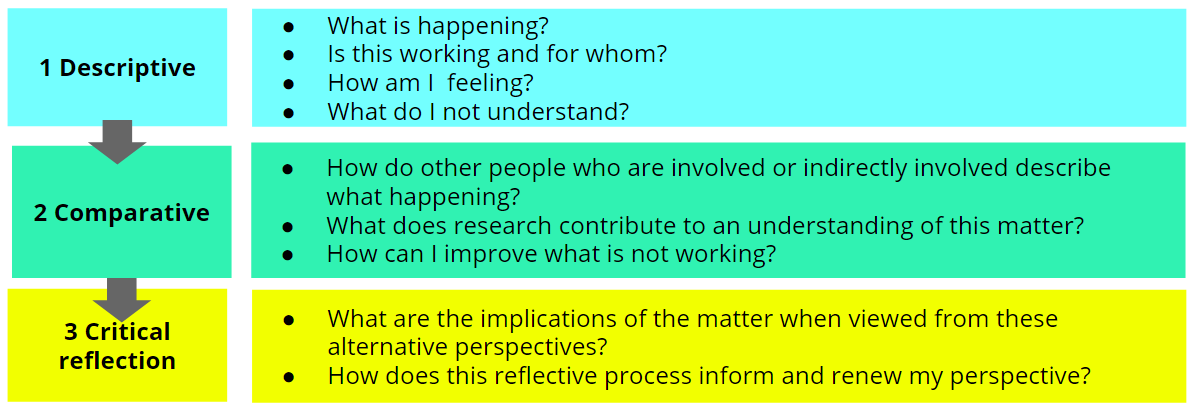
My post this week relates to reflective practice. In response to this I will consider as a school leader the impact that this course has had on my professional practice as a leader using aspects of the Hack Education themes. I will discuss this considering what happened using Rolfe’s (2001) reflective model to unpack it. This takes the form of three simple questions, “what”, “so what” and “now what”.
What?
The Mindlab's 2016 portal of Hack Education in which the trigger statements “In the future education will be…”, “In the future education will not have…” and “I wish education…” were answered and subsequently analysed into 13 themes/concepts as shown in the picture below and from the research of Parsons et. al (2017, p61) this allows me to reflect on the areas of my practice related to collaborative, technological, future focused, digital and 21st Century Skills Based as a leader of a primary school.

I have also felt a huge responsibility as an educational leader to promote within our staff a Learning-focused culture as required within Our Code, Our Standards for the teaching profession where this is described as:
- Learning-focused culture - Develop a culture that is focused on learning, and is characterised by respect, inclusion, empathy, collaboration and safety (p. 20).
So What?
 |
| CC Licence for public use |
As a school leader, I am wanting our teaching team to collaborate together and provide the best learning opportunities for our students in order to be future focused. I have reflected on the use of digital technologies for both staff work streams and student learning. Seeing the value of participating in this course and encouraging as many staff members as possible to participate, I have had to have a positive mindset and show ways of working that the workload for this course, as well as teaching and family commitments can be achieved. It has been important to encourage others on the course to speak positively rather than negatively about the workload (this has been the biggest challenge, and one that hasn't fully been achieved). Although I can see positive changes in daily practice for each of the staff members involved in the course, it is hard for them to see beyond the workload capacity that this new learning has brought to encourage others to participate.
In promoting a learning-focused culture I have developed digital systems in order for staff to collaborate and reflect using teaching as inquiry with a collaborative inquiry lens. This process has been iterated several times in order to explore adaptive leadership and being agile in order to meet the needs of the staff (this has been my biggest reflective area and change in practice). Recognising through feedback that the digital system created wasn't working for staff and providing coaching and changes to get what is required for effective teaching as inquiry and learning-focused culture it was important to refine and revise our digital system for staff reflection on the changes in their practices. I need to relate these changes also to the professional standard so that staff can see explicitly the link to the learning-focused culture standard.
Now What?
I need to continue promoting effective digital work flow and consider the parameters of professional learning for all staff to feel comfortable working and teaching in a digital world. As a staff next term we will complete the digital passport created by MindLab and several staff have also committed to becoming Google Certified Educators Level 1 - being a Google for Education NZ Leader, I will be running a study group each week to support our staff.
In order to reflect on digital innovations at our school, I need to work with a team of educators that looks closely at our Tinker Time innovation to create a rubric that identifies a progression of learning. This document would support staff to understand how our learners participating in the Tinker Time innovation are meeting the achievement objectives and process outcomes of the digital technologies curriculum. I envisage that this will link to 21st Century skills and attributes and link back to our newly created GEMS foundation of learning curriculum at Sunnyhills School.
I will continue to lead by example in digital leadership within my school context and wider professional networks that I am involved with. I will encourage our staff on this Post Grad Certificate in Applied Practice my support to successfully complete their professional learning by continuing to dedicate time in our meeting schedule for them to focus on their professional improvement. I will also encourage the graduates that form our Sunnyhills Community of Practice to continue to be innovative and feel comfortable to explore the digital possibilities for our learners and to share this practice with all our team, so that all classes at our school can benefit from our new learning.
Word Count: 803 words
References:
Ministry of Education (2017). Our code, our standards. Retrieved from https://educationcouncil.org.nz/content/our-code-our-standards
Parsons, D., Lynch, J., Han, B., & Thorn, R. (2017). Hack education: Crowdsourcing the future of education in New Zealand. In S. Nash and L.L.M. Patston (Eds.), Spaces and Pedagogies: New Zealand Tertiary Learning and Teaching Conference 2017 Proceedings (pp. 57–66). Auckland, New Zealand: ePress, Unitec Institute of Technology.
Rolfe, G., Freshwater, D., Jasper, M. (2001) Critical reflection in nursing and the helping professions: a user’s guide. Basingstoke: Palgrave Macmillan.
Image credit: https://pxhere.com/en/photo/1379760