Saturday, 31 March 2018

TML Week 17: Reflective Practice

Reflective practice is one of those terms that is touted as current best practice for being responsive to the needs of our learners and dare I add in my leadership role, responsive to our staff and community needs.  It has become an integral part of the cycle of teaching as inquiry for effective pedagogy, a practice that is now widespread as a means for educational improvement and improved teacher quality. However after reading through the article by Finlay (2008), I would postulate that it is not done with the depth of understanding to truly be reflective.  The important element of critical analysis required for reflection-on-action as Schön (1983, cited in Finlay, 2008) describes as ‘after-the-event-thinking’ is often missing. In this post, I attempt to use a three step model by Jay and Johnson (2002) to critically reflect on my own reflective practice.


Jay and Johnson (2002) Reflective Model
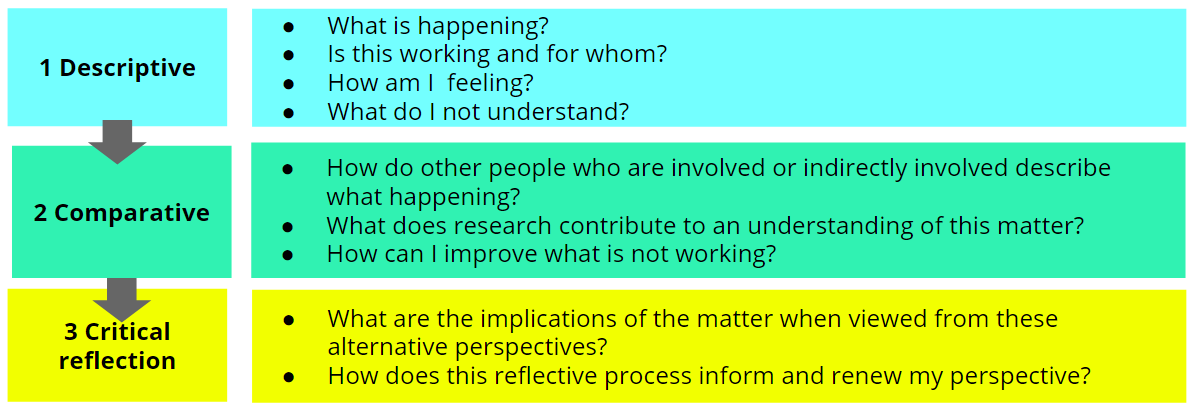
Stage 1: Descriptive
In my own practice, as an educational leader, I do not believe I reflect to the best of my ability, despite good intentions.  In a time poor environment where I am driven to juggle many tasks and manage events on a situational basis, I feel I need to be more selective and spend time to reflect and draw clarity to the events around me for future learning and leadership. I am often caught up with situations that arise unscheduled, where I have to be agile and this requires me to take a reflection-in-action (thinking while doing) approach.  I often find that I then personally reflect on my own after a situation or event on my actions, my feelings and what I would do differently in the future based on my own gut feeling and hindsight.

Stage 2: Comparative
When given the opportunity to meet with a colleague, my leadership team, or in a professional learning group, I have the time to digest an event and reflect more deeply on my actions, the situation and contemplate how to adapt if this event or similar was to occur again.  When reflecting with others, if this is verbal or completing a PMI chart of an event, I am drawn to the many perspectives that I would not have had while in an isolated internal thought structure. This interaction allows me to consider multiple perspectives, feelings and therefore new information for me to add to my personal professional knowledge and mental model.  I also find when I reflect with my professional learning group, we are often reflecting against our own practice and a current topical reading. For example, currently my professional learning group is reading Dylan Wiliam (2016), Leadership for teacher learning. I find relating relevant readings when reflecting on a situation or event can be helpful to uncover what the wider educational community have found through research.  However, I must include in this part of the reflective process that through being a connected educator and leader, I will often seek perspectives from social media. I tend to post on a closed Facebook group for New Zealand Principals, or on Twitter to seek advice.

Stage 3: Critical reflection
After connecting with others through online forums or in person (partner, team or group), and considering relevant readings (or research) I find I am able to draw conclusions and considerations to add to my personal professional knowledge.  Through these connections I know that when confronted with a new situation or event, I am often more poised to respond in-the-moment (reflection-in-action) by appropriately drawing on hindsight of previous experience, collective wisdom gained through discussion and readings, and ready to seek further feedback from my colleagues.

Word Count: 599

References

Finlay, L. (2008). Reflecting on reflective practice. Practice-based Professional Learning Centre, Open University. Retrieved from http://www.open.ac.uk/opencetl/sites/www.open.ac.uk.opencetl/files/files/ecms/web-content/Finlay-(2008)-Reflecting-on-reflective-practice-PBPL-paper-52.pdf

Jay, J.K. and Johnson, K.L. (2002). Capturing complexity: a typology of reflective practice for teacher education. Teaching and Teacher Education, 18, 73-85.

Schön, D.A. (1983). The reflective practitioner. New York: Basic Books

Sunday, 28 February 2016

#Educamprotovegas

On Saturday 27th February at the crack of dawn I picked up +Fiona Grant and +Karen Ferguson to head south for a day of learning and connecting at #educamprotovegas held at Rotorua Girls High School.  We made it with time to spare and it was a great opportunity to see some of my awesome PLN face to face and meet new educators that I can now call upon.  The day started with a really informative smackdown - where participants had only 2 minutes maximum to share an idea, app or educational gem.


I shared in the smackdown about the +GEG NZ learning community and our upcoming GEGNZ Studygroups that will help educators in NZ attain level 1 in the new Google for Education certifications.
After the smackdown and lunch break we then had the opportunity to select two breakout sessions - I listened to +Steve Katene share the learning journey of Richmond School in Napier where he is DP for his learners and coaches (teachers) which was really inspiring! This guy has great energy and I'd love to take a visit to his school to see it in action.  I'm looking forward to revisiting his slide deck.
I was super pleased to meet my old student teacher and colleague +Robyn Keightley for her first Educamp.  She travelled over from Tauranga and ended up sharing twice in the smackdown and then led a breakout session on the 1:1 ipad journey her school had made.
Thanks to +Annemarie Hyde and +Marnel van der Spuy for being great hosts and organising this event! It was well worth the 450km round trip!
Here are the tweets from the session:

Friday, 15 January 2016

Are you a Connected Leader?

The Connected Learning Advisory (CLA) runs webinars each month, and I was asked to be part of a  Webinar on and for "Connected Leaders" on the 21 October.   The aim of the CLA is to provide interactive opportunities for sharing practice, discussion of key ideas and connection to experts and other educators.

What a great opportunity I thought to give back to the education sector and contribute some gems on helping the sector connect. The other connected leaders were Marnel van der Spuy, Stephen Lethbridge, Rachel Boyd and Annemarie Hyde and together we answered the following:

  • What does a “connected leader” look like ?
  • In your role as a connected leader, what do you do to support/model/advocate/facilitate e-learning ?
  • What attributes do you think you need most, to make this role successful?
  • How would you encourage a reluctant teacher/ leader to get connected?


Sunday, 18 October 2015

#EdBlogNZ Challenge Week 2

#NotAtULearn15 - Get thinking Deeper!
So this week's challenge I've decided to do a bit of a combo and while I've done a few posts already on events that I've participated in during #ULearn15, for the majority of the week I've not been at ULearn15!  On the Friday morning there was a panel discussion that was streamed live facilitated by +Derek Wenmoth that I watched firstly on my phone then Chromecast to our 50" TV in the comfort of my lounge!  I love how Pam Hook challenged the status quo and didn't necessarily go along with the "group-think".  I'll add more detail of my points of highlight (when I find the notes I hand wrote at the time of watching)... watch this space


Here is the Twitter feed from the discussion that I kept an eye on while watching the video:

Saturday, 10 October 2015

GEG_NZ at #ULearn15

I became part of the Google Educator Group New Zealand (GEG_NZ) community on Google Plus right from it's inception in July of 2014, this year I was asked to join the leadership team, helping to organise events.  I jumped at the opportunity to Learn.Share.Inspire.Empower myself and other educators associated with this community.

Our session at ULearn was co-led with +Fiona Grant, myself with +Rob Clarke joining us virtually through Google Hangout.  It was also great to have an international contingency in the room with +Kimberley Hall and +Jim Sill. Fiona and I ran a tag team through the face to face presentation with Rob contributing through the session. It's fantastic to be such of a supportive group of GEG leaders and community.  I learn so much each time we meet and connect, along with the contributions made to the G+ community for GEG_NZ. 
Here is our slide deck from the session:
Here's some tweets from the session:

#Twitterdinner15

This year I organised the annual #twitterdinner that coincides with the #ULearn conferences each year in the October school holidays for educators in New Zealand.  Each year the event alternates between Auckland and Rotorua (previously held in Christchurch too). The evening was awesome with 58 educators that connect on line, face to face in the same room ready for great conversations, food and connections!

The dinner was held at Sweat Shop Brew Kitchen.  On arrival tweeps checked in with me to get their name label and +Megan Croll gave them their free drink token (thanks to +Jenna Kleine of Class Dojo and +Alex Le Long) and the mix n' mingle bingo sheet.  The bingo sheet was a great icebreaker and our guests being the connected individuals they are, were up for the challenge of completing it to truly embrace the opportunity for rich connections to start the evening.  Delicious canapes were served and circulated during this time.  Then it was time for a word from our sponsor from +Alex Le Long and +Campbell Potter in support of Class Dojo.  I said a few words of welcome and then the rest of the evening rolled out into a great talk, food and photo fest! The photo booth props were a fun addition (although a little under-used). We trended on Twitter and here are some of the tweets from the evening!
I enjoyed organising the evening and would do so again if the opportunity arises - my one wish for next time would be to circulate more! I felt that I didn't really get the opportunity to do as much mix n' mingle at the beginning with checking everyone in and of course, once you're sitting and eating that can be a bit restrictive too... however I thoroughly did enjoy myself and l look forward to hopefully attending next year's one in Rotorua!

Tuesday, 6 October 2015

#EdBlogNZ Challenge Week 1

Inspiring Bloggers
The challenge is to write about a legendary blogger that inspires you or makes you dream bigger.  I am in awe at how some educators write reflect so frequently on their blogs.  Two bloggers that I follow and read regularly both bear the same name Stephanie Thompson!  I wonder if they are connected on line too?

First Stephanie who is the author of Four Seasons in One Kiwi I first met her at a two day Solutions Focus Coaching Master class. Stephanie is a primary school principal and as I aspire to be a principal I was really impressed with what she had to say about leadership and growing a coaching culture in her school.  Her blog posts reflect her leadership wonderings and I find them useful to read and reflect how her message resonates with me now (in my role as an acting principal) and to store for my future leadership experiences to come.

Second Stephanie who is the author of Train the Teacher I had connected with her many years ago on twitter and first met a few years ago at an Ignition Conference held at Albany Senior High School.  At the time she was a classroom teacher in Wellington, a tweeter and edu-geek.  I was impressed for a beginning teacher how she used blogging to collect evidence of her practice and labelled her blogs as a great filing system.  Now Stephanie teachers overseas and posts almost daily of her educational learning journey, whether she is reflecting on what is happening in her classroom or from one of the many conferences that she attends.  Her latest post about participating in a disruptive strand at a conference reminded me of the robust conversations I had at the Google Teacher Academy where we put our big ideas into an action plan for immediate steps in our learning community.

I often fear that my reflections will just be aimless ramblings and not worthy of the deep reflection I read in the posts of others.  I do believe in projecting positivity and continuous improvement, so to move forward, I feel you need the time to look back and reflect on your practice to improve. Like ripples in a pond, ideas can grow, reverberate and merge to create new circles of ideas.  I wonder if participating in the #EdBlogNZ challenge will help me get into a routine of weekly reflection (or at least fortnightly) for my leadership and/or education learning journey?  I hope so!